
Human Skeleton Anatomy
The human skeleton is a complex structure that serves as the framework for the body, facilitating movement, providing support, and protecting vital organs. It consists of 206 bones, along with ligaments and cartilages.
ubdivisions of the Skeleton
The skeleton is divided into two main parts: the axial skeleton and the appendicular skeleton.
1. Axial Skeleton: This includes the vertebral column (spine), much of the skull, and the rib cage. The axial skeleton provides the main support for the body and protects the central nervous system.
2. Appendicular Skeleton: This comprises the pelvic (hip) and pectoral (shoulder) girdles, and the bones and cartilages of the limbs. The appendicular skeleton facilitates movement.
Functions of the Skeleton
1. Support: The skeleton provides structure to the body. The vertebral column, corresponding to the notochord in lower organisms, is the main support of the trunk.
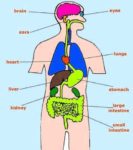
2. Protection: The skeleton protects vital organs. The brain is surrounded by the skull, the heart and lungs are located within the thoracic cavity, and the vertebral column protects the spinal cord.
3. Motion: The skeleton, in conjunction with muscles and nerves, enables body movement. Muscles are attached to bones, and nerves signal these muscles to contract, producing movement at the joints between bones.
Types of Bones
Bones can be classified into five types based on their shape and function:
1. Long Bones: e.g., the femur.
2. Flat Bones: e.g., the frontal bone.
3. Sesamoid Bones: e.g., the patella (knee cap).
4. Short Bones: e.g., carpals (in the hand) and tarsals (in the feet).
5. Irregular Bones: e.g., vertebrae.
Ligaments and Cartilage
Ligaments are bands of dense and fibrous connective tissue that are key to the function of joints. Cartilage is more flexible than bone but stiffer than muscle. It helps give structure to the larynx and nose, and is also found between the vertebrae and at the ends of bones like the femur.
In conclusion, the human skeleton is a marvel of biological engineering, providing support, protection, and mobility to the human body. Its intricate design and functionality underscore its crucial role in human anatomy..