The human body is a complex structure made up of many parts, one of the most important of which is the skeletal system. The skeletal system provides support, protection, and movement to the body. It consists of around 206 bones in an adult, decreasing from 270 bones at birth due to the fusion of certain bones.
The skeleton is divided into two main parts: the axial skeleton and the appendicular skeleton.
Axial Skeleton (80 bones)
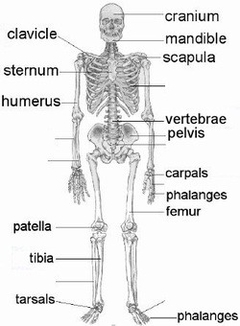
– Skull (22 bones): Includes the cranial bones (8) and facial bones (14).
– Vertebral Column (26 bones): Comprises cervical vertebrae (7), thoracic vertebrae (12), lumbar vertebrae (5), sacrum (1, fused from 5 bones after adolescence), and coccyx (1, fused from 4 bones at birth).
– Thorax (25 bones): Consists of the sternum (1) and ribs (24 in 12 pairs).
Appendicular Skeleton (126 bones)
– Upper Limbs (64 bones): Each upper limb has 32 bones, including the humerus, radius, ulna, carpals (8), metacarpals (5), and phalanges (14).
– Lower Limbs (62 bones): Each lower limb has 31 bones, including the femur, patella, tibia, fibula, tarsals (7), metatarsals (5), and phalanges (14).
There are also several small accessory bones, such as sesamoid bones, not included in this count.
The bones of the human body are categorized by their shape and function into five types:
1. Long Bones: These are longer than they are wide. Examples include the femur and humerus.
2. Short Bones: These are approximately as wide as they are long. Examples include the carpals and tarsals.
3. Flat Bones: These bones have a flat, thin surface. Examples include the sternum and ribs.
4. Irregular Bones: These bones have complex shapes. Examples include the vertebrae and certain skull bones.
5. Sesamoid Bones: These are small, round bones found in tendons. The patella is an example.
It’s important to note that the number of bones can vary between individuals due to anatomical variations, such as additional cervical ribs or lumbar vertebrae. The human skeletal system is a marvel of biological engineering, providing the framework that allows us to interact with our environment.